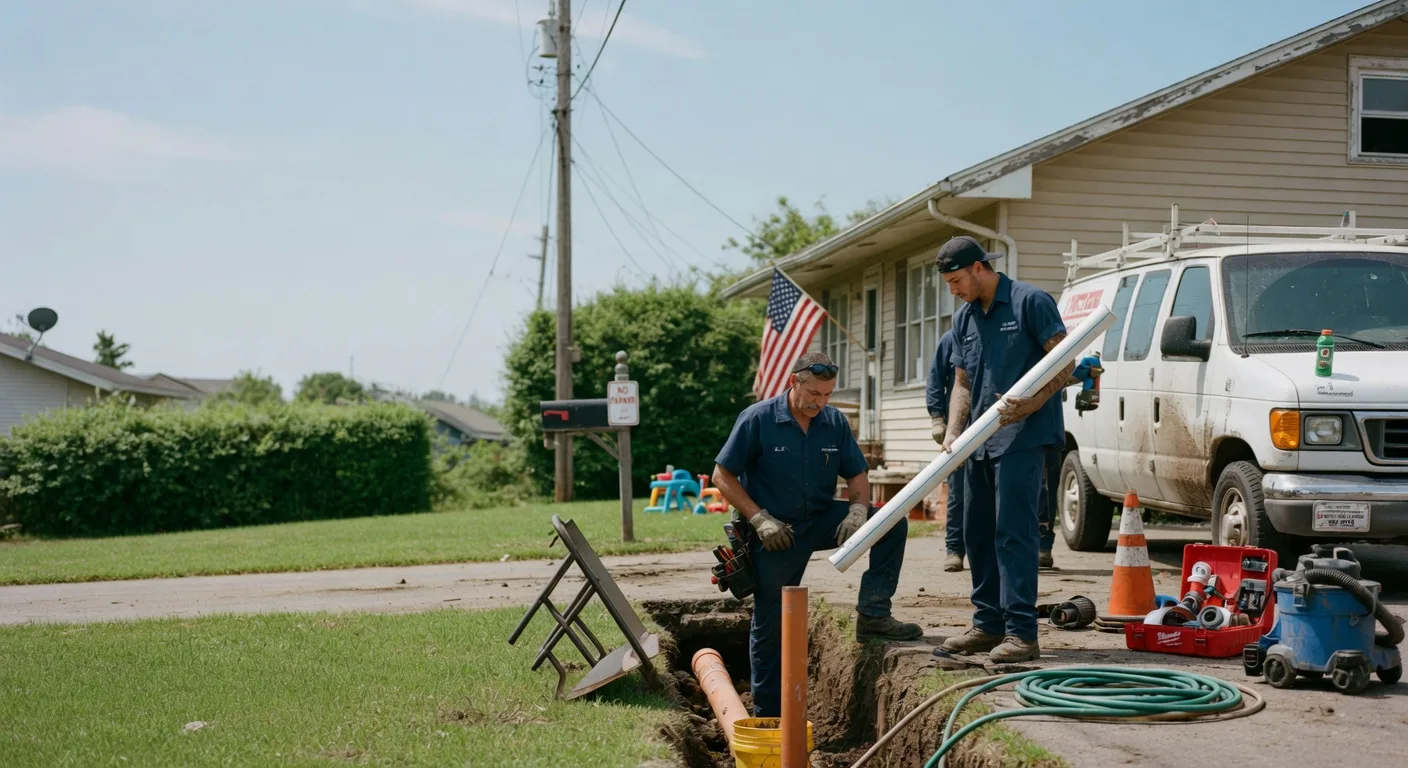
Why does the same drain keep clogging again just days after it was cleared?
A clog that returns within days almost always means one of two things. Either the first cleaning opened a path without removing the whole blockage, or the real cause was never touched. A cable machine punches a channel through the middle of a clog. That restores flow, but it can leave a ring of grease, scale, or packed debris clinging to the pipe wall, and that ring catches the next load of waste quickly. Underneath that sit the causes a cable cannot fix: roots growing in at a clay joint, a bellied section holding standing water, a cracked or offset joint catching paper, or rough scale in cast iron. Start by noting whether it is one fixture or several. A single kitchen or bathroom line that refills fast often needs hydro jetting, which scours the full width of the pipe wall rather than opening a hole through the center. A repeat clog in the main, or several fixtures slowing together, needs a camera inspection, because it shows the pipe's condition instead of just clearing it again. Chemical cleaner between visits usually makes things worse for the next tool. Expert Plumbers Co connects homeowners in West Farmington, ME with an independent local plumber who can find out why the drain will not stay clear. Access to the line and how much of it must be opened up are what shape the repair.
Clearing a drain is not the end of the story, and knowing what to do afterward keeps the clog from coming back. Once a line is cleared, run hot water for a minute, then fill the sink and let it drain to check the flow. Use a drain strainer in showers and kitchen sinks to catch hair and food scraps before they enter the pipe. Keep a note of the date and what the plumber found, because a second clog in the same place within a few months is useful information. If hair is the cause, a monthly manual clean of the strainer and stopper helps more than any product. If the plumber mentions roots, a bellied pipe, or a cracked joint, ask what the options are and how quickly the problem is likely to return. Older homes often have cast iron or clay lines, where recurring trouble is more common than in newer plastic pipe.
Why do my drains back up only when I run the washing machine?
When the washing machine drains and water comes up in the shower or a floor drain, the machine is rarely the problem. It dumps a lot of water in a short burst, and the line behind it cannot carry that volume away. Something is narrowing the pipe: grease and lint built up on the pipe wall, roots pushing in at a clay joint, or a bellied section that holds water and slows the flow.
Where it shows up tells you a lot. If only the laundry standpipe overflows, the blockage is probably in the branch line serving the machine, and a cable machine often clears that. If the lowest drains in the house gurgle or back up too, the blockage is further down, in the main line or a failed sewer lateral. That is a different job. It usually calls for hydro jetting or a camera inspection to see what is actually in there.
Safe homeowner checks: make sure the drain hose is not jammed tight into the standpipe, and try a smaller load. Do not keep running loads to see if it clears. Every cycle pushes more water toward the lowest opening in the house.
If water is coming up inside the house, stop using the washer, sinks and toilets and call. Expert Plumbers Co is a referral service, not a plumbing company. We refer you to a local plumber for Drain Cleaning in West Farmington, ME: (380) 262-9173.
Watch for a pattern in when it happens, because that helps separate a drain problem from a venting or plumbing layout issue. If the backup always appears on the second or third load, the line is partly blocked and fills as the volume builds. If the washer is on a long run that ties into the main near a bathroom, the surge can push air and water into the nearest fixtures. Older homes often have laundry drains that were added later with a smaller pipe or an awkward connection, which cannot keep pace with a modern machine. A common mistake is placing a lint trap on the end of the drain hose and assuming it solves everything. It catches fibers, but it does not clear buildup already in the pipe. Tell the plumber the machine type and how many loads you run in a day.
Can a drain under a concrete slab be cleared without breaking the floor?
Usually, yes. Clearing a blockage and repairing a broken pipe are two different jobs, and only the second one needs the floor opened.
In a slab-on-grade house the drain lines run inside or beneath the concrete. There is no crawlspace to inspect, so symptoms are the only evidence you have. A cable or a hydro jetter still reaches the line through a cleanout or through a pulled toilet. Grease build-up on the pipe wall, roots in a joint and scale in cast iron can all be cleared that way.
What does need the floor opened is a cracked, collapsed or bellied section under the slab. A bellied line holds water and collects waste however often it is cleared. In older housing stock where clay or cast iron was the standard, failed sections are more likely.
A camera inspection with a locator pinpoints the fault. The plumber finds the exact spot and marks it on the floor before anything is cut, which keeps the opening small. What the job involves is driven by access, the materials, how much concrete must be opened and removed, and any permit or code requirement. Opening a slab often brings one in.
Safe homeowner check: note whether one fixture is slow or every drain is affected. A single slow fixture is usually a cable job on a branch line. Every drain backing up points to the main line or the sewer lateral.
Stop running water and call now if the whole house is backing up. Report water staining or a warm, damp patch on the floor, because it can mean a leak under the slab.
Expert Plumbers Co is a referral service. We refer homeowners in West Farmington, ME to an independent local plumber. Call (380) 262-9173.
A spot repair under a slab is more disruption than most people picture. The plumber breaks out a section of concrete, digs down to the pipe, replaces the damaged length, and the floor is patched. Dust, noise and a few days without some fixtures are normal. Furniture and flooring over the area must be moved first, and tile or a finished floor may not match after patching.
For longer runs of damage, some plumbers can line the pipe from inside, or route a new line overhead or outside the house, which avoids cutting the slab. Whether either suits your pipe depends on its condition and on local code.
Ask to see the camera footage and the locator mark on the floor before any cutting begins. Mention in-floor heating, radiant tubing or a post-tension slab if you have one. Cutting into those without knowing is dangerous, so the plumber needs to hear about them before a saw comes out.
The furnace or air conditioner drains into my basement floor drain and now it overflows. Is that a drain cleaning job?
"The furnace drains into my basement floor drain and now it overflows." That is a common one, and it is a drain problem with two parts. The overflow can come from either end: the small condensate line, or the floor drain it empties into.
Condensate lines clog with algae and sludge. Once it blocks, water backs up at the unit or spills from the line onto the floor. Many systems also have a trap on that line, and the trap is the first place sludge collects.
The floor drain itself can be the problem. If it is slow or backs up when you run the washer or a tub upstairs, the cause is in the house drain: grease build-up, a bellied line holding water, or root intrusion at a clay joint further out.
One slow floor drain, with the rest of the house draining fine, usually means a local blockage in that branch. Every drain in the house backing up, or the lowest drain gurgling and rising while others run, points to the main line or a failed sewer lateral.
Safe homeowner check: Look at the pipe from the unit. Is water standing in the pan or trap? Pour a bucket of water into the floor drain and watch how fast it goes. Do not pour bleach or drain chemicals into the condensate line without knowing the unit's instructions.
Stop running water and call now if the floor drain is bringing up sewage or a sewer smell, other drains in the house are slow or gurgling, water is spreading toward electrical equipment or the furnace, or the overflow comes back soon after you clear it.
A cable machine is often enough for a plain clog in the floor drain branch. A condensate line is a different job: it needs flushing or clearing at the line and trap, and may need a cleanout fitting added. If the floor drain keeps backing up, a camera inspection shows whether the main line has roots or a belly. Hydro jetting is used when grease or scale coats the pipe wall.
Expert Plumbers Co is a referral service. We connect you with an independent local plumber in West Farmington, ME. Call (380) 262-9173.
Ask the plumber to check both the condensate line and the floor drain, and to explain which one failed. Ask whether the condensate should drain somewhere else, since rules vary by area on where it may discharge. Cost depends on access, the parts needed, how much has to be opened up or removed, and any permit or code requirement.
Our older house has a house trap, or running trap, in the basement. Why does it keep clogging?
Your basement drain backs up every so often, and each time someone points at the house trap and clears it again. In an older house that is a familiar story.
A house trap, also called a running trap, is a U-bend on the main drain near the foundation wall, with two cleanout plugs. It holds water to keep sewer air out. The trouble is that the dip slows the flow and gives solids a place to settle. Paper, grease, wipes and roots that pass through a straight pipe pile up in the bottom of the bend, so the trap becomes a frequent stoppage point.
Old lines make it worse. Scale in cast iron roughens the pipe and catches debris before it reaches the trap. Root intrusion at a clay joint outside sends fibres toward it. A bellied line downstream can hold water back so the trap never fully clears. Many traps were removed over the years, and local code on keeping or removing one varies.
One slow fixture is usually its own branch problem. If toilets, tubs, sinks and the washer all slow down together, or the floor drain bubbles, the trap or the main beyond it is the likely spot.
Safe homeowner check: Stop using water and look at the two trap plugs without opening them. Check whether the floor drain is holding water, and note which fixtures back up first.
Stop running water and call now if sewage is coming up from a floor drain or shower, if you smell sewage in the basement, or if a plug is weeping. Never loosen a trap plug under pressure, because sewage can surge out.
A cable machine is often enough to clear the trap itself when the stoppage is soft. Hydro jetting is the better choice when grease or scale lines the pipe on either side. A camera inspection is the right step when the trap keeps clogging, because it shows whether the real fault is a belly, a root-filled joint or a failing section further down.
Expert Plumbers Co is a referral service. We connect you with an independent local plumber in West Farmington, ME. Call (380) 262-9173.
Ask whether the trap can stay and be cleaned when needed, or be removed where code allows. The scope depends on basement access, the condition of the pipe on both sides, how much floor has to be opened up, and any permit or code requirement for changing the main.